




Table of Contents
A campaign that contacts every registered voter the same number of times, through the same channel, with the same message, is wasting most of its budget. Some of those voters are already certain to support you and vote. Others are certain not to. The contact effort that actually moves your win number is the slice in between — and finding that slice is what a GOTV voter universe is for.
This guide covers how to build that universe: scoring voters by propensity, segmenting them by geography and demography, sizing the list against your real contact capacity, and running the timeline of contact stages through election day. It’s one piece of the broader complete guide to GOTV campaigns rely on to win close races.
What is a GOTV voter universe?
A voter universe is the specific list of voters a campaign commits contact resources to — not the full voter file, and not just your confirmed supporters. It’s the set of people whose vote is genuinely in play or genuinely needs a reminder, sized to what your volunteers and channels can actually reach before election day.
Building it starts with a projected turnout and a win number, moves through scoring and segmenting individual voters, and ends with a timeline that tells your team who to contact, when, and through which channel.
Calculate your win number and turnout gap
Before you can size a voter universe, you need to know how many votes you need and how many you’re currently projected to get. Use recent comparable elections (same electorate, same election type) to project turnout and your current support share:
- Projected turnout — average turnout across the last three comparable elections.
- Win number — projected turnout × 0.50 (+1 vote) for a marginal win, or × 0.52 for a comfortable margin.
- Projected voter base — your historical vote share as a percentage, averaged across those same elections.
- Voter gap — win number minus (projected turnout × projected voter base). A positive gap is what your voter universe has to close.
A small or negative gap means your universe can lean on supporters and regular voters. A large gap means you need to reach further into swing and sporadic voters — which is exactly what propensity scoring is for.
Score voters by propensity
A voter propensity score estimates two things separately: how likely someone is to support you, and how likely they are to vote at all. Voter file vendors and campaign data teams typically model this from vote history, party registration, and demographic data, but a campaign without access to a modeled score can approximate the same thing manually by cross-referencing support level against voting regularity:
| Consistently support | Swing voters | Consistently oppose | |
|---|---|---|---|
| Regular voters | Voting supporters — minimal contact needed | Persuadable — contact and persuade | Will vote opponent — skip |
| Sporadic voters | Definitely pursue — needs a reminder and a plan | Pursue if capacity allows | Low priority unless the gap is large |
| Consistent non-voters | Pursue to fill a large gap | Low priority | Skip |
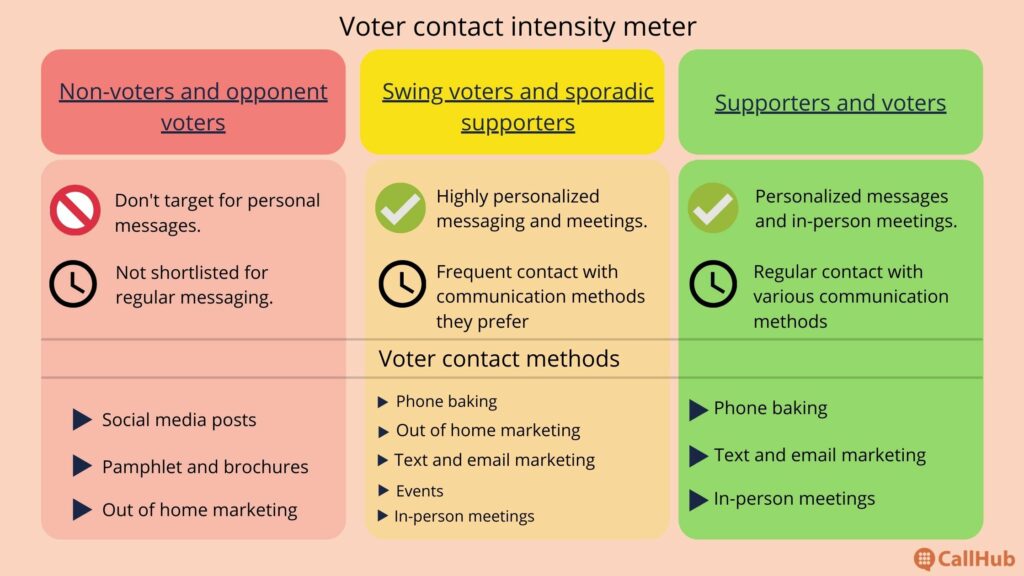
A low-propensity voter — a supporter who votes rarely or unpredictably — is usually where a GOTV universe gets the most value per contact, because a persuasion campaign has typically already done the work of confirming their support. A high-propensity voter who already votes every cycle needs little more than a reminder near the end of the timeline.
Segment the universe by geography and demography
Once you know which voters to target, divide them further so contact can be assigned efficiently:
| Geography metrics | Demography metrics |
|---|---|
| Average turnout percent, expected vote count, historical party performance, swing precincts | Age, race, locality (urban/rural), education, profession, income |
The geographic cut tells you which turf to prioritize and lets you estimate turnout by precinct. The demographic cut tells you which messaging and which local organizations — advocacy groups, unions, nonprofits — are worth partnering with for that specific slice of the universe.
Size the universe against your contact capacity
A voter universe is only useful if your volunteers can actually work through it before election day. Before committing to a target list size, check it against realistic capacity: how many calls, texts, or doors your volunteer base can cover per shift, multiplied by the number of shifts left on the calendar.
If the universe is larger than your capacity, cut from the bottom of the propensity table first — low-priority swing and non-voter segments — rather than reducing contact frequency evenly across the whole list.
Run the contact timeline
The universe and its segments determine a four-stage contact timeline. Reverse-plan from election day: allocate days to each stage based on how large the universe is and how much persuasion versus mobilization it needs.
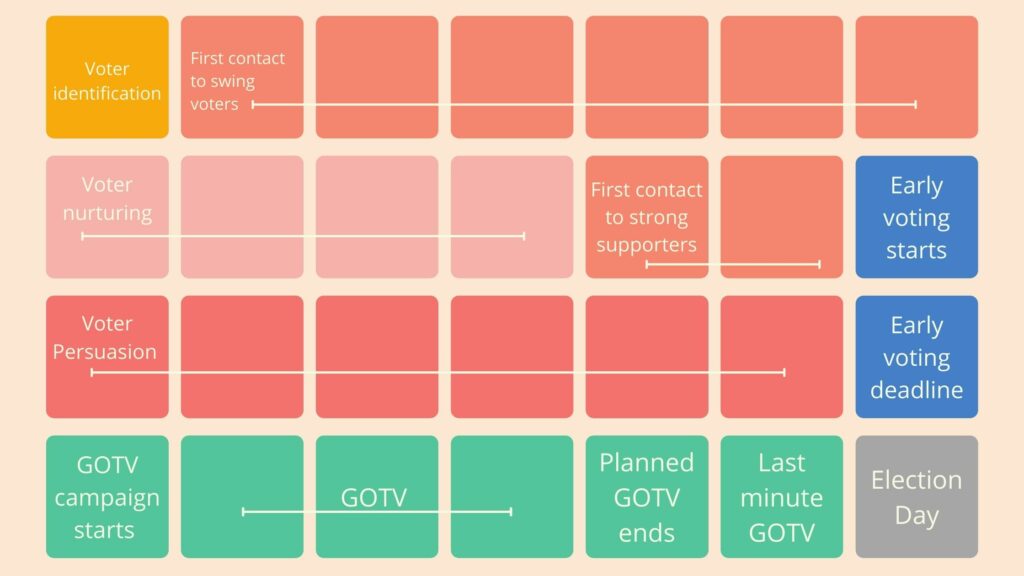
- First contact — a cold touch (literature drop, broadcast message, or call) that introduces the campaign, confirms registration, and gets the voter opted in for future contact.
- Second contact: persuasion — intensity scaled to where the voter sits in the propensity table, from 0–1 touches for non-voters and opponent voters up to 4–5 for swing and sporadic supporters.
- Final contact: GOTV — starting about a week out and running through the day before the election: confirming the voter’s plan, signing commitment cards, and canvassing.
- Encore: final nudges — on election day itself, for supporters who still haven’t voted, using the fastest channels available — phone banking and texting.
Push early-voting messaging starting at second contact rather than waiting for the final push — it gives voters more ways to complete the exact action you’re asking for.
Track every voter with a contact card
Every voter in the universe needs a record that follows them through all four contact stages, not just a single call log. At minimum, track:
- Contact details and polling district
- Party affiliation and projected support level (0–5)
- Registration status and voting plan
- Requested help (rides, absentee ballot, more information)
- Volunteering interest
Sync these cards into your CRM alongside your phone banking and texting tools so every contact stage updates the same record instead of living in separate spreadsheets.
A voter universe isn’t a one-time list — it’s a live model that should tighten as each contact stage returns new data. Recheck propensity and segment assignments as first-contact and persuasion results come in, and reallocate capacity toward whichever segment is closing your voter gap fastest.
Building a GOTV Voter Universe: FAQs
What is a voter contact universe?
A voter contact universe is the specific list of voters a campaign targets for GOTV outreach. It's built by calculating who needs contact, then dividing that list by geography and demographics so outreach can be prioritized and staffed correctly.
How do you calculate a GOTV voter universe?
Start from your full target voter list, determine which voters are eligible supporters who haven't yet voted, then segment them by geography and demography to decide contact priority and channel assignment.
What is the difference between first contact, persuasion, and GOTV contact?
First contact identifies where a voter stands. Second contact focuses on persuasion based on what first contact revealed. The final GOTV contact mobilizes already-identified supporters to actually vote.
How many times should a campaign contact a voter in its GOTV universe?
Contact should follow the voter contact plan's timeline rather than a fixed number — each stage (first contact, persuasion, GOTV, and final nudges) builds on the result of the one before it.
When should a campaign stop persuading and switch to GOTV-only contact?
Once a voter is confirmed as a supporter, further contact should shift from persuasion to GOTV — reminders, logistics, and a voting plan — rather than continued persuasion messaging.
Why segment a voter universe by geography and demographics?
Segmentation lets a campaign match contact methods and messaging to each group's likely barriers and preferences, instead of running one generic outreach approach across the entire universe.
Feature image source: Alexis Brown/Unsplash.